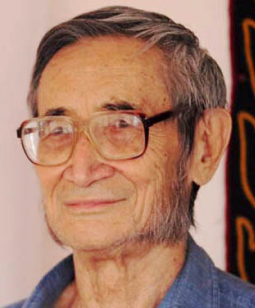
Emil Japarovich Shukurov (1938–2019) — Ornithologist, Candidate of Biological Sciences, Doctor of Geographical Sciences, Professor, Honored Scientist of the Kyrgyz Republic, full member of the New York Academy of Sciences, Chairman of the “Aleyne” Ecological Movement of Kyrgyzstan
E. J. Shukurov, born in 1938, ethnic Kyrgyz, graduated from Kyrgyz State University, Faculty of Biology and Soil Science, specializing in biology and zoology, in 1960; completed graduate studies at the Faculty of Biology and Soil Science of Moscow State University in 1962. Candidate of Biological Sciences (1968), Doctor of Geographical Sciences (1992), Professor (2001), Honored Scientist of the KR (2002).
To reach any goal, one must know the path to it. And, strangely enough, one must also know the goal itself. Because the path to nearer goals often leads away from a more distant one.
Governance is the organization of actions to achieve a goal. When it comes to state governance, this includes defining the goal and choosing the means to achieve it. There is nothing above the state that acts on a national scale and in the interests of the entire population. And the interests of the state must coincide
In the past, the mountain ranges were not the obstacle for horseback travelers that they have now become for motorists. Through the Kyrgyz Ala-Too, almost every gorge led to bountiful summer pastures — jailoo. One such gorge is Kegeti, located east of Bishkek between the basins of the Issyk-Ata and Shamshy rivers.
Vecherniy Bishkek, October 5, 2012.
The country's largest gold-mining enterprise is once again coming under attack. This time, representatives of a certain public association, 'Tenir-Too Yntymak Toby,' claim to be acting on behalf of the residents of Naryn.
The development of ideas about human nature. In every age, people have pondered who they are, how they came to be, and why they exist in the world. At first, they did not distinguish themselves from other living creatures, or even from inanimate objects
We live in a world that is becoming ever more simplified. Moreover, in a world becoming ever more primitive. What is wrong with that? The problem is that, in such a world, what is good keeps getting worse. Life is being replaced by degeneration. For the worse hinders the return, the revival, of the good.
Human activity that does not take into account the need to conserve nature and its most important part — biological diversity — leads to the degradation of habitats.
The history of the modern type of human, the true human, begins with the appearance of the phenomenon of culture in the world. Humans evolved from pre-human ancestors not when they began making tools and laboring (animals are capable of this too), but when they began to produce and consume the phenomena of culture.
One of the tasks of nature reserves and national parks is environmental education activity.
This essay is based on the publication: Shukurov, E.J. The Natural and Anthropogenic Environment of Kyrgyzstan. (Academy of Sciences of the Republic of Kyrgyzstan, Kyrgyz Committee 'Man and the Biosphere,' Institute of Management under the Cabinet of Ministers of the Republic of Kyrgyzstan. Bishkek, 'Ilim,' 1991).
The main operating principles of these plots are the creation and use of restorative successions, launched within microterritories, and the promotion of the restoration of local hotspots of biodiversity and food chains.